How to Identify Aspen Trees in the UK: A Beginner's Guide
Aspen gives itself away before you have identified a single leaf. Stand near a stand of it on a breezy afternoon and you will hear a soft, dry rustle that seems out of proportion to the wind, while the canopy shivers and flashes as every leaf twists to show its paler underside. Get closer, though, and you need a few dependable features to be sure of what you are looking at. Here are the clues in the order you are most likely to meet them.
Start with the leaves
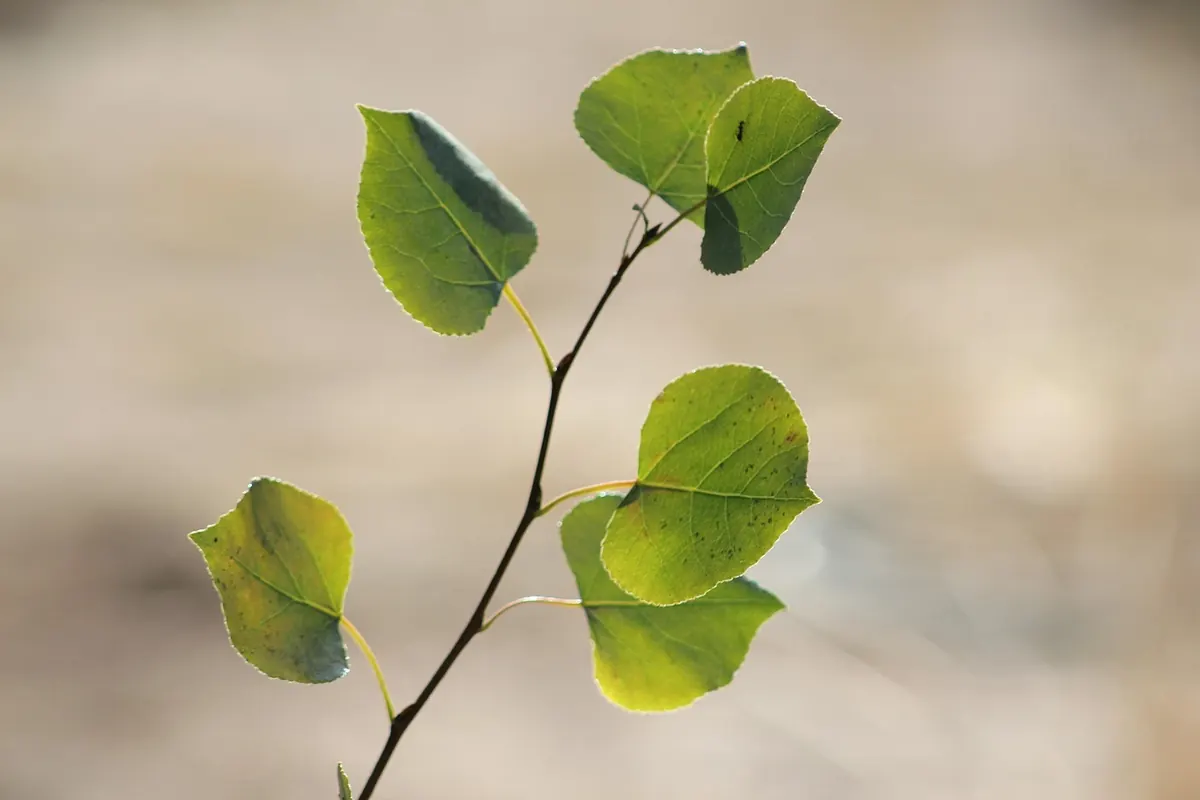
Aspen (Populus tremula) leaves are rounded, roughly 3–8cm across, with a bluntly pointed tip and a wavy, scalloped edge. The teeth are small and rounded rather than sharply saw-toothed, and the base of the leaf is rounded or faintly heart-shaped. Colour is a fairly plain mid-green above and slightly paler below, and both surfaces are usually smooth rather than hairy. Check how the leaves sit on the twig: they are alternate, not arranged in opposite pairs.
The giveaway is the stalk. Pick a leaf and roll the stalk between finger and thumb — it is flattened, more like a strip of ribbon than a cylinder, and often longer than you expect. That flat stalk is why the leaf dangles and twists instead of holding stiffly away from the twig. Leaves on vigorous young shoots can be larger and more triangular than those on short, mature shoots, so check several before deciding.
The tremble, and what it tells you
Because a broad, light leaf blade balances on a flattened stalk, the slightest air movement sets it turning. Watch the canopy and you will see leaves flickering constantly, showing silver-green, then green, then silver again. This is the trembling that gives aspen its name — Populus tremula, the trembling poplar. Listen as well: a dense stand has a distinctive papery rustle, often audible when other trees around it are still.
If a tree is quivering when the air around it is barely moving, start hunting for flattened leaf stalks.
Bark, buds and winter clues
Young aspen stems are smooth and pale — grey-green to greenish-white, sometimes with a bloom that makes them look dusty. You will find small dark marks scattered along them, and on older trunks the bark becomes rough, dark and ridged, with fissures that often join up into diamond or lattice shapes. Aspen does not peel in papery sheets the way birch does, which is a useful distinction when the leaves are gone. In winter, look at the buds: pointed, reddish-brown, glossy and slightly resinous, sitting alternately along the twig. A winter stand of aspen looks like a crowd of slender grey-green poles, usually all much the same age.
Catkins and early spring
Aspen is dioecious, meaning male and female flowers grow on separate trees. Catkins appear in late winter and early spring, usually before the leaves are fully out, hanging like grey woolly lambs' tails. Male catkins open to show dark red or purple anthers, while female catkins are greener and lengthen as they ripen. Later in the season, female trees release tiny seeds attached to white cottony fluff, which drifts on the wind in early summer much as willow seed does. The seed needs bare, damp ground and does not stay viable for long, which is part of the reason aspen so often spreads by root suckers instead. Look for grey woolly buds and catkins on bare twigs in March and you may well find aspen before most other trees have woken up.
Aspen or something else?
Several UK trees can look similar at a glance. Work through the differences rather than relying on a single feature.
- Silver birch: also pale-barked, but birch leaves are roughly triangular with sharply double-toothed edges and hang in a light, weeping fashion. Birch bark peels away in horizontal papery strips; aspen bark does not.
- Grey poplar (Populus × canescens): the closest lookalike. Its leaves can be aspen-like, but they are grey-white and felted underneath, and leaves on strong shoots are often lobed or maple-shaped. Aspen leaves are never lobed and never white beneath.
- White poplar (Populus alba): leaves are deeply lobed and white-felted below — obvious as soon as you turn one over.
- Willows: many produce grey catkins in spring, but willow leaves are long and narrow, often silky-haired, and their buds sit pressed close against the twig rather than standing out pointed and glossy.
- Rowan: shares the pale bark and upland haunts, but its leaves are pinnate, made up of many small leaflets along a central stem.
Where to look
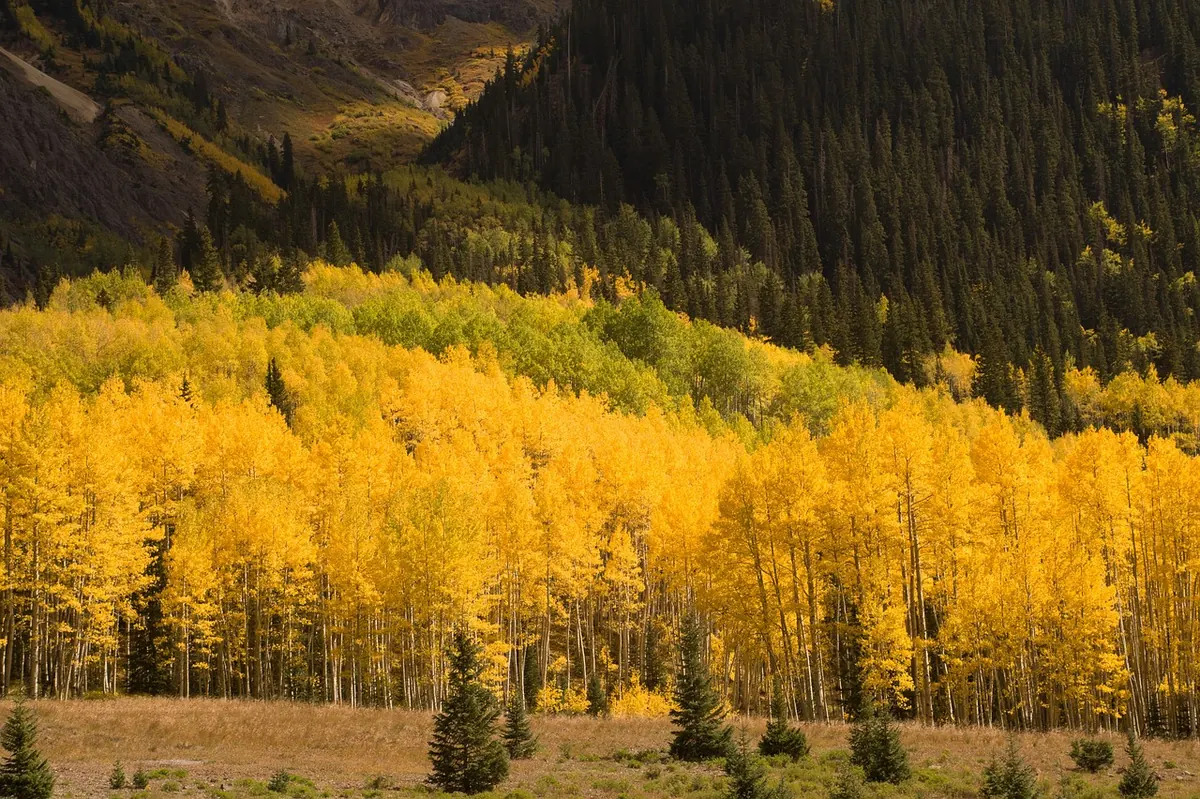
Aspen is native to Britain and is most often found in the uplands — Scotland, Wales, the Pennines and the wetter west — growing on damp slopes, stream sides, woodland edges and rocky ground. It behaves as a pioneer, turning up on disturbed ground, old quarries, road banks and clearings. Look for it in loose groups or small stands rather than as a lone tree, and bear in mind that a group may be a single clonal colony joined underground by its roots. That is why every stem in a colony can come into leaf, and turn gold in autumn, at almost exactly the same moment.
A quick field checklist
Stand still, listen for the rustle, then work through these:
- Is the canopy flickering in only a light breeze?
- Are the leaves round, with wavy rounded teeth, and alternate along the twig?
- Does the leaf stalk feel flat when you roll it between finger and thumb?
- Are the leaves plain green underneath, rather than white or grey-felted?
- Is the bark smooth and pale on young stems, with no birch-style peeling?
- In early spring, are there grey woolly catkins on otherwise bare twigs?
Three or four yeses and you can be confident. Aspen rewards a little patience: once you have heard that rustle and felt that flattened stalk for yourself, you will spot it from a moving car for the rest of your life.
Photo: natkat / Pixabay
Aspen Leaf Miner and Other Common Pests: A UK Troubleshooting Guide
How to read the damage on aspen leaves and bark, from serpentine leaf-miner trails to gall mites and rust,...
Designing with Aspen: Landscaping Ideas for Small and Large UK Gardens
From flutter-leafed specimen trees to coppiced multi-stem features, here's how to use native aspen in UK...
About Us